

The Production Process of Kutani Ware
Written by Team Japan Kutani
Kutani ware is a traditional craft from Ishikawa Prefecture. Both historically and artistically, it is an exceptional form of pottery that Japan proudly presents to the world. Take a closer look at the process of how Kutani ware is made, step by step.
TABLE OF CONTENTS
1. Quarrying
Kutani ware is made using Hanasaka pottery stone quarried in Komatsu City, Ishikawa Prefecture. Hanasaka pottery stone was discovered in the late Edo period (1603–1868 CE), and quarrying has continued ever since, supporting the production of Kutani ware even today.

2. Clay Making
The pottery stone is crushed and refined through a series of steps to produce clay. Known for its high iron content, Hanasaka pottery stone yields a rich, grayish-white clay body with a distinctive warmth. Its natural plasticity also makes it well-suited for shaping on a potter’s wheel. In recent years, clay makers have developed new types of clay tailored for slip casting as well.

3. Shaping
This is the step where the clay is shaped into form. There are several different methods used.

The photo shows wheel throwing, a method where a lump of clay is placed on a rokuro (potter’s wheel) and shaped as it rotates. It's used to create various items such as sake cups, dishes, and vases.
Ikomi (slip casting) is a forming method where liquefied clay is poured into plaster molds. This method is used for both ornaments and dishes and is well suited for mass production.
A traditional method for shaping figurines is te-okoshi (hand-press molding). Individual molds are made for each part, clay is packed in by hand, then removed and assembled to form a complete piece. Because it is labor-intensive, slip casting has become the mainstream method for making figurines.
Hand forming, or tebineri in Japanese, is a traditional method that involves rolling clay into long coils, stacking them, and joining them together to form a piece.
Tatara forming, also known as slab building, involves flattening clay into sheets of even thickness, which are then shaped—such as into squares—or joined together to create more complex pieces.
4. Bisque Firing
The shaped vessels and ornaments are fired in a kiln. In the past, they were fired in wood-burning climbing kilns, but today, gas and electric kilns are more common.
Below is a kiln at Miyayoshi Seito, a Kutani ware kiln.

The clay is fired at around 800°C (1,472°F) for six to seven hours.
Bisque-fired bowls removed from the kiln with a soft reddish-brown hue.

5. Glazing
Glazing is the process of applying glaze (yuyaku) to a bisque-fired vessel. Pottery glaze is a liquid that, when fired at high temperatures, turns into a glassy coating that covers the surface of the piece. Artisans dip the bisque ware quickly and evenly into the glaze, working with speed and precision to ensure a uniform finish—a skill honed through experience.

6. Glaze Firing
Similar to bisque firing, glaze firing was traditionally done in climbing kilns, but today, gas and electric kilns are more common.
The photo below shows the kiln at Miyayoshi Seito, tightly packed with glazed pieces ready for firing.

This firing is done at a higher temperature than the bisque firing, approximately 1,300°C (2,370°F), and takes around twelve to fifteen hours.
Once the glaze firing is complete, the clay body turns white, and the glaze becomes clear and glossy.

7. Overglazing
Outlines and patterns are drawn on the now white glaze-fired piece using gosu. Gosu is a pigment that contains cobalt, manganese, iron, and other elements.
The photo below shows gosu and red Japanese pigments (wa-enogu) applied before firing.

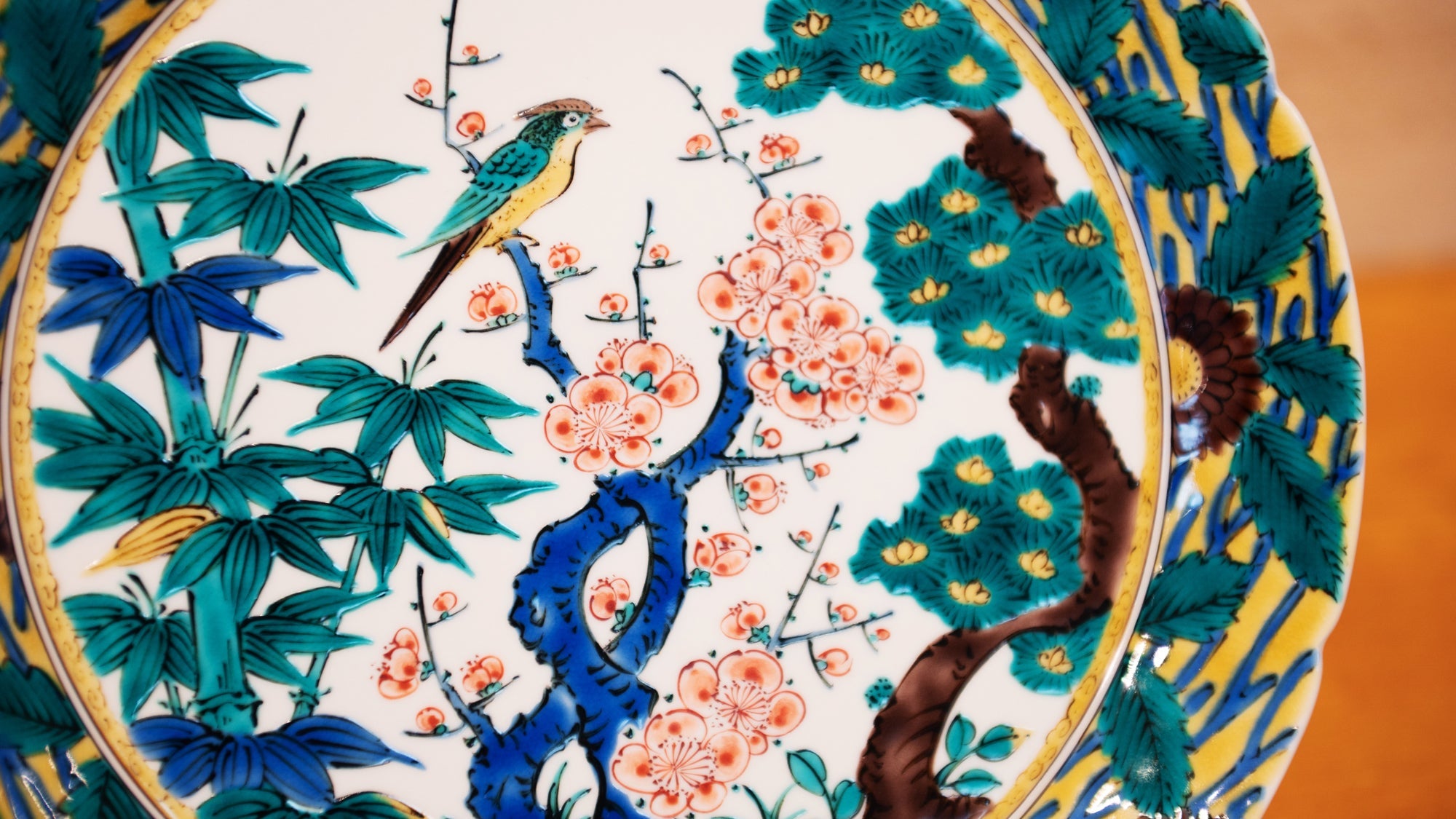
Traditional Kutani ware is painted with black gosu outlines and the five classic Kutani colors: green, yellow, purple, navy blue, and red. As the black gosu and red pigment are applied first, the remaining four colors are layered over the black gosu lines and patterns. Care is taken not to layer other pigments over the red, as doing so would cause it to disappear during firing.
When the Japanese pigments are applied, the black gosu lines may temporarily become obscured, but they remain intact beneath the layers.

8. Overglaze Firing and Completion
The piece is fired at 800 to 900°C (1,472 to 1,652°F), which sets the pigments onto the surface of the vessel.

During firing, the pale Japanese pigments transform into vivid hues. As the four Kutani colors become glassy and slightly translucent, the gosu outlines beneath begin to show through, revealing intricate patterns. This transparency is one of the signature characteristics of Kutani ware.

Kutani ware is created through a precise and lengthy process, with each artisan expertly carrying out their part with refined craftsmanship. Clay specialists prepare the clay. Craftspeople responsible for shaping and firing create the ceramic bodies. Decoration artisans carry out the decorative work. Each stage is completed with care and professional skill.
Firing is carefully managed, with temperatures adjusted through experience. Glazes, pigments, brushes, and other tools are all essential to the process.
Not a single step in the production process is overlooked. Kutani ware is a true showcase of dedication to the craft of ceramic ware.
Popular posts

Categories


2 comments
@Gail – Thank you for contacting Japan Kutani Shop. We truly appreciate your interest in Kutani ware.
Regrettably, we are unable to offer appraisal or identification services. Japanese ceramics have a long and diverse history, with numerous kilns, makers, and styles that have evolved over many generations, making it challenging to provide detailed information about individual pieces.
We apologize that we are unable to assist with your inquiry, and we appreciate your understanding.
Japan Kutani Shop
I was gifted a plate from Japan approxamately in 1985 …how can i find out if it is a peice of Kutani ware…it has very similar characteristics…thanks Gail
Gail Loughridge
Leave a comment
This site is protected by hCaptcha and the hCaptcha Privacy Policy and Terms of Service apply.