
Kutani Ceramic Laboratory: Painting Workshops in a Forest-Like Space
Written by Team Japan Kutani
Paint Your Own Piece and Discover Bold New Kutani Ware: Kutani Ceramic Laboratory
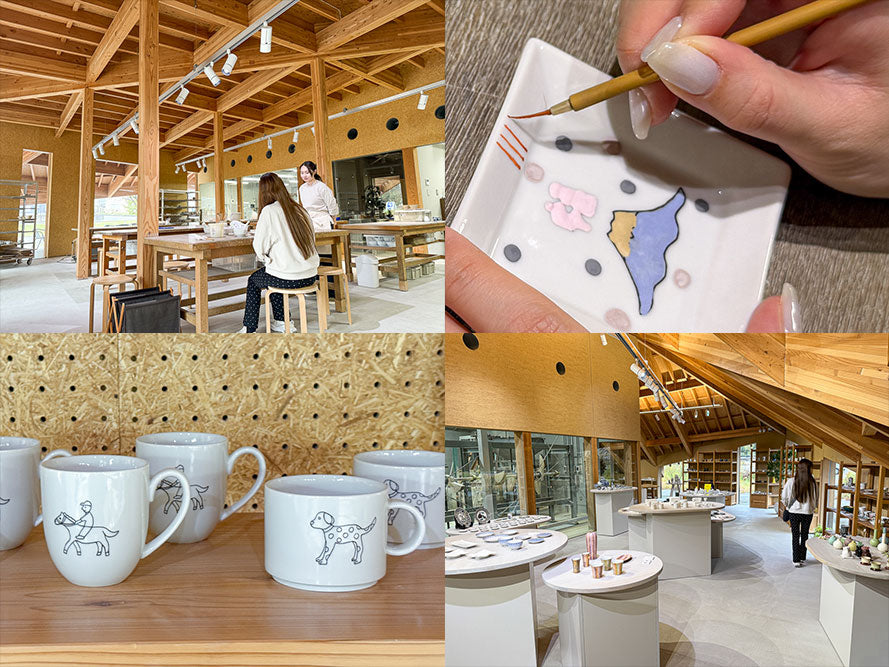
Kutani Ceramic Laboratory, known as CERABO KUTANI, is a Kutani ware cultural complex in Komatsu, Ishikawa. Designed by Kuma Kengo, the building makes generous use of Ishikawa cedar, and its interior feels as calm and refreshing as a walk in the forest.


TABLE OF CONTENTS
Painting: Choosing Your Piece
At CERABO KUTANI, choosing what to paint is half the fun. Options range from plain pieces

to figurines.

The pieces come from local kilns, and the shelves are lined with many unpainted bodies. The selection changes over time, so each visit may bring an encounter with something new. There is also a wide range of pieces with pre-drawn outlines that you can color in like a coloring book.

Choosing a piece here is truly a one-time encounter.
Here is the piece we chose.

We went for one with pre-drawn outlines, which seemed likely to turn out well even for a beginner. Our session was led by a working Kutani ware artist based in one of CERABO KUTANI’s studios.

The instructor explained carefully how to use the brush and apply color.
Painting: Working with Wa-enogu
CERABO KUTANI uses wa-enogu, the traditional Japanese enamels that are the mainstream in Kutani ware. Six colors are available: the five Kutani colors of green (called ao, “blue,” in Kutani), yellow, purple, dark blue and red, plus pink.

First, water is added to the enamel in a mortar and it is ground thoroughly.

Rather than brushing it on, the idea is to load the brush generously and set the enamel onto the piece.

Deciding which color goes where is part of the fun.

For the rim, we decided to paint a tokusa pattern of vertical stripes in red, but our hand shook, so the instructor let us practice on another piece first.

With any of the enamels, a mistake can simply be wiped off and redone as many times as needed.

And at last, the painting was done.

The finished piece was ready about a month after the workshop.

Once fired, wa-enogu takes on beautiful, glossy color.

Its plump thickness is characteristic of Kutani ware.
Painting course
- Fee: ¥3,080 (tax included), plus ¥550–1,100 for the piece depending on type (tax included), plus shipping (free if collected in person); prices are per piece and include admission
- Start times: 10:30, 12:00, 13:30 and 15:00
- Time required: About 60–90 minutes
- Finishing and shipping: Within 30 days of your visit
- Age: Generally elementary school age and up
Wheel-Throwing: Making Your Own Vessel
Wheel-throwing is another draw at CERABO KUTANI. Using local clay, you can throw a teacup, rice bowl, guinomi sake cup, plate or other vessel of your choice.


The studio has four electric wheels operated with a foot pedal, and as with painting, the instruction is careful and reassuring.

Wheel-throwing course
- Fee (per piece, tax included, admission included): Small (guinomi, soba choko cups, etc.) ¥3,630; medium (rice bowls, free cups, etc.) ¥3,960; large (matcha bowls, donburi bowls, etc.) ¥4,400; each plus shipping (free if collected in person); additional clay ¥2,200
- Start times: 10:30, 11:30, 12:30, 13:30, 14:30 and 15:30
- Time required: About 60 minutes, up to four people per session
- Finishing and shipping: Within 60 days of your visit
- Age: Generally 10 and up
Hand-Building: Shaping with Your Fingertips
The appeal of hand-building is that making a vessel feels like playing with clay. Kneading the clay is soothing in itself. You turn a hand-operated wheel as you shape the piece however you like.


Staff support hand-building too, explaining the method and sharing small tips.

Like a return to childhood, hand-building is easy to get absorbed in.
Hand-building course
- Fee (per piece, tax included, admission included): Teacups, rice bowls, guinomi, plates, etc. ¥3,960, plus shipping (free if collected in person); additional clay ¥2,200
- Start times: 10:30, 11:30, 12:30, 13:30, 14:30 and 15:30
- Time required: About 60 minutes, up to 15 people per session
- Finishing and shipping: Within 60 days of your visit
- Age: All ages
The Gallery: Work by Artists and Kilns
Another highlight of CERABO KUTANI is the chance to see vessels by a range of artists and kilns, and to buy any you like. Simply browsing the many fine works is a pleasure.


Work by more than ten Kutani ware artists and kilns is always on display and for sale, each with its own character. Because the makers and items change over time, it is the kind of place you want to return to.
Learning About Kutani Ware: An On-Site Clay Plant
Next to the gallery is a working clay-processing plant, with porcelain stone on display.

Komatsu is home to the Hanasaka district, where the porcelain stone that is Kutani ware’s raw material is quarried.

At CERABO KUTANI, you can learn how Hanasaka porcelain stone is crushed and made into clay while watching the plant at work (it does not operate every day).

Clay is made from quarried Hanasaka porcelain stone, the clay becomes vessels, and the vessels are painted. Seeing the raw material, the process and the finished piece in one place is one of the most notable things about CERABO KUTANI.

It brings home that Kutani ware depends on Hanasaka porcelain stone, quarried since the Edo period, and on the clay-making skills passed down with it.
Rental Studios: Artists at Work
CERABO KUTANI has two individual studios that serve as a training ground for young artists, where visitors can watch pottery making and painting up close.

We were also able to see the artists’ work.


With hands-on workshops for painting, wheel-throwing and hand-building, a gallery where you can buy the works on display, a working clay plant and studios where you can watch artists at work, CERABO KUTANI has it all. It is a place we recommend to anyone who loves Kutani ware or ceramics.

Kutani Ceramic Laboratory (CERABO KUTANI)
- Address: 91 Wakasugi-machi a, Komatsu, Ishikawa
- Tel: 0761-48-4235
- Hours: 10:00–17:00 (last entry 16:30)
- Closed: December–March, Tuesdays, Wednesdays and the year-end and New Year holidays; April–November, Wednesdays (open on holidays, closed the next weekday instead; may close temporarily for maintenance; the clay plant does not operate every day)
- Admission: Adults ¥300; students (high school and younger) ¥150 (workshop fees include admission)
- Workshops can be booked through the official website.
Popular posts

Categories


Leave a comment
This site is protected by hCaptcha and the hCaptcha Privacy Policy and Terms of Service apply.