
Kokuzou Kiln: The Warmth of Handmade Kutani Ware
Written by Team Japan Kutani
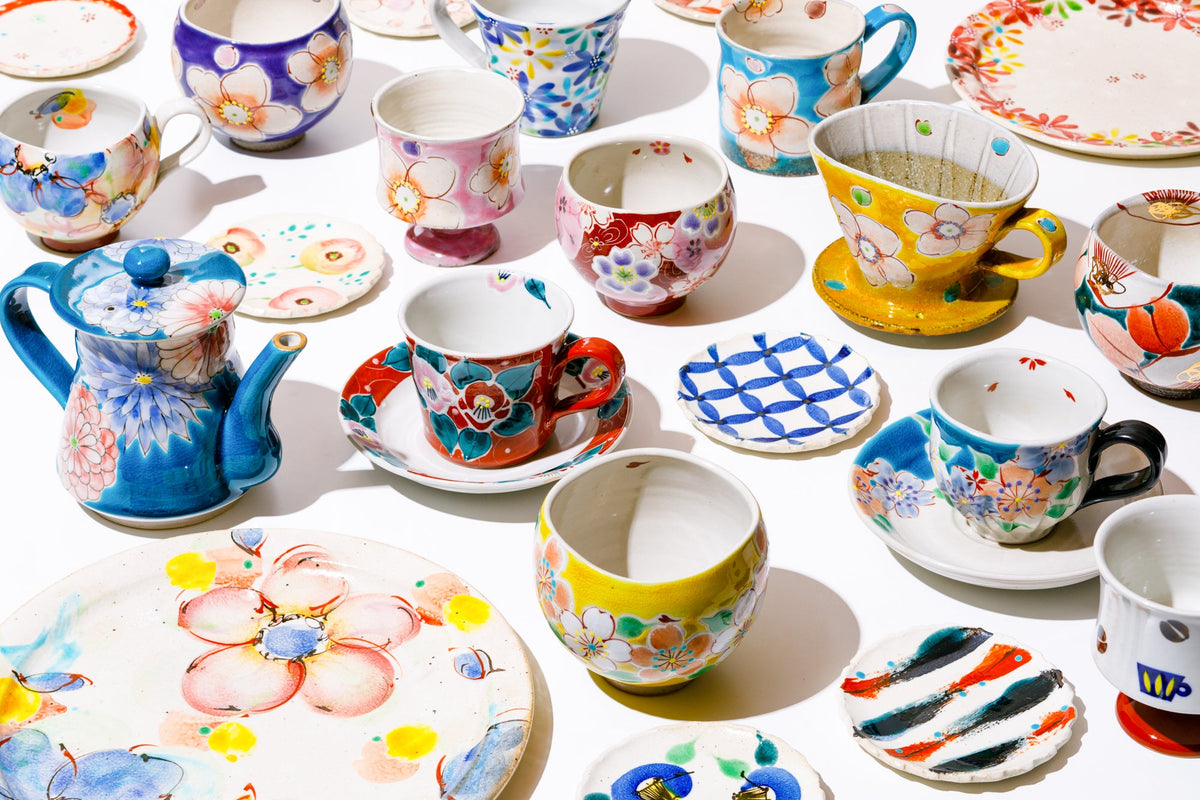
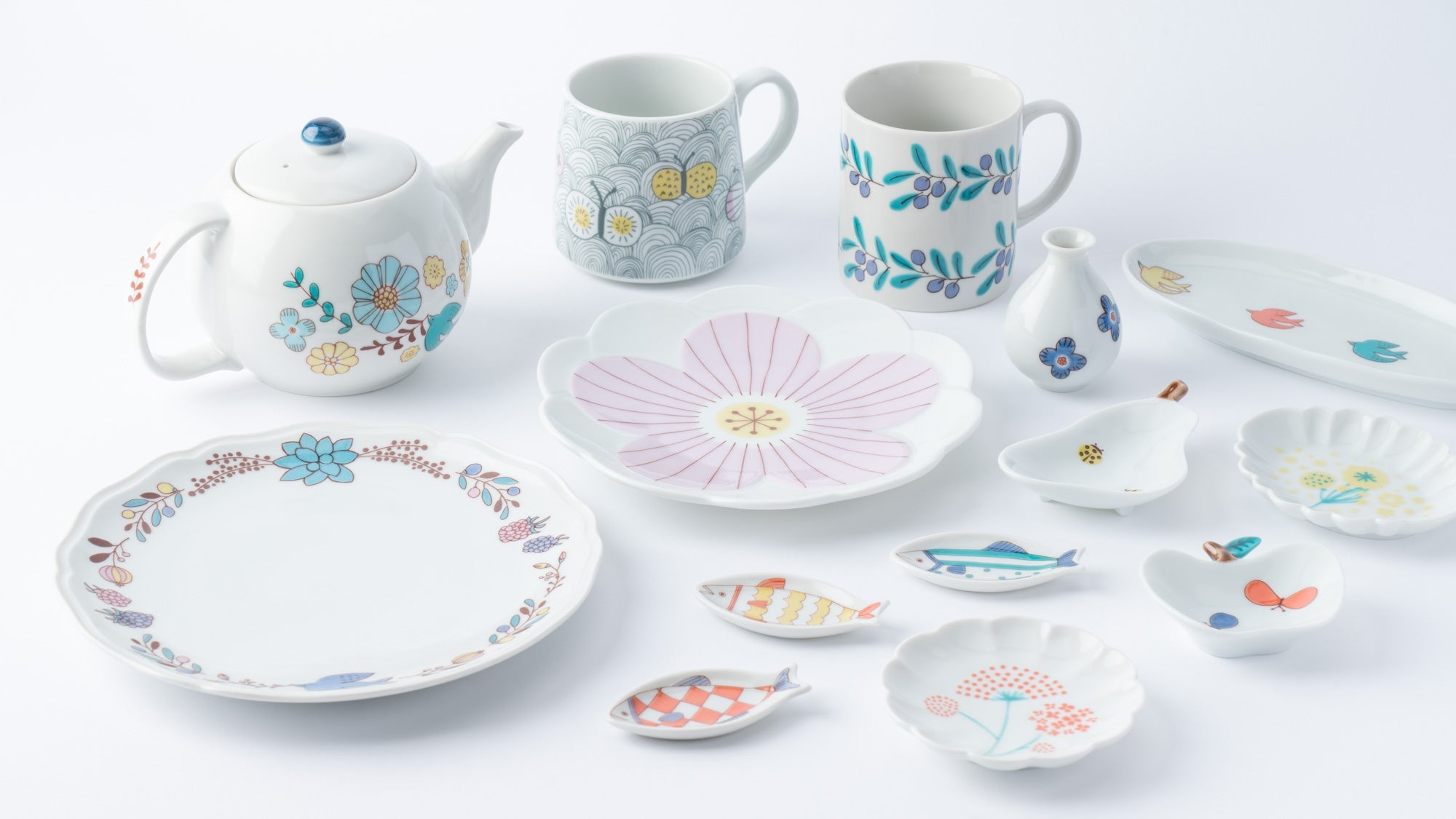
Founded in 1997, Kokuzou Kiln is one of the few kilns in the Kutani ware industry that handles every stage in-house, from forming the clay bodies to painting and firing. It also focuses on tsuchimono, stoneware, which is unusual in a tradition dominated by porcelain. Kokuzou Kiln’s vessels have the texture and warmth of stoneware and the character of hand-painting, and they are comfortable to use. With their original forms and designs, they stand out within Kutani ware.
TABLE OF CONTENTS
The Ippuku Teacup, the Kiln’s Best Seller
A full, rounded form, the warm texture of stoneware and patterns carefully painted by hand one at a time: the Ippuku Teacup (a Japanese yunomi teacup) is central to Kokuzou Kiln’s identity.

“The Ippuku Teacup has been one of our products since the early days, when my predecessor founded the kiln,” says Ichida Takahiro, head of Kokuzou Kiln.
Since the Ippuku Teacup is stoneware, has the kiln worked in stoneware since its founding? “Yes, I’ve heard that stoneware was the main focus,” Ichida says. “My predecessor’s idea was to make warm, handmade vessels unlike mass-produced goods. I think stoneware suited the vessels he wanted to make better than porcelain, the mainstream of Kutani ware. That has continued to this day and become part of what makes Kokuzou Kiln itself.”

Kokuzou Kiln’s combination of stoneware and handmade texture does set it apart within Kutani ware, and the Ippuku Teacup, which comes in many designs, remains one of its main products. “It’s a long-selling product for us,” Ichida says. “In my predecessor’s time there were about 300 designs of the Ippuku Teacup alone. We made the bodies and did all the hand-painting in-house even then, so considering the size of the kiln, it’s remarkable how much we made. Now we offer around 50 designs, focusing on the most popular, for the Ippuku Teacup and the slightly smaller Ippuku Teacup (Small).” Every Ippuku Teacup is formed on the wheel, one at a time.

Have the shape and designs stayed the same since the founding? “The shape became what it is now as we listened to customers and others. Because we make everything from the body to the painting at our own kiln, we can respond flexibly at any time. That’s one of our strengths,” he explains. “The designs have changed over the years, but some from the founding period remain. Ko-some Tsubaki, a camellia design in the style of old blue-and-white, is one of them.”

Seeing the Ippuku Teacup and the smaller version side by side, we were reminded that making many pieces of the same shape, and painting the same design the same way each time, looks simple but in fact takes real skill. We admired the work of the wheel-throwers and painters.
The Distinctive Turkish Blue Series
Most of Kokuzou Kiln’s items are painted, but the Turkish Blue series stands apart. These pieces have no painting at all and are fired only with a turquoise-blue glaze.

“We went to a glaze maker and developed this turquoise glaze, mixing and mixing until we finally reached the blue we wanted,” Ichida says. “But finishing the glaze wasn’t the end. The next hurdle was the firing temperature. The shade of blue changes with the temperature, and bubbles form. I think it took about a year before we could reliably make pieces in the color we envisioned. Developing the Turkish Blue series was probably the hardest of all.”

The central figure in its development was Ichida Tetsuya, who is also a wheel-thrower. We asked him why he wanted to make the series. “I’ve always loved blue, the color of the sea sparkling in the sun,” he says. “And while I can’t paint, I can make forms. I wanted to make appealing products through form alone, without relying on painting. Form and the color I love: the Turkish Blue series is what came from pursuing those.”

We had heard from Ichida Takahiro that the series was hard won. “People sometimes think it must be easy because there’s no painting, but not at all,” Ichida Tetsuya says. “Developing the glaze and working out the firing temperature took time, and firing is still difficult; I can’t relax any time. Even so, there are losses, so it’s a demanding product.” Other regions make turquoise-glazed wares too, but we found the silhouettes of Kokuzou Kiln’s pieces especially fine, and the care and originality in their forms came through clearly.
Thoughts on Form

“Handmade work is what Kokuzou Kiln is about, so I don’t want to make anything that could be made in a mold,” Ichida Tetsuya says. “We make vessels that can only be expressed by hand, with wheel-throwing or slab-building.”
Does the mug he is making now have something that only handwork can give? “Yes. After throwing it on the wheel, I pull the rim out in three places to distort it on purpose. That gives it a softer impression. Then the sides: I trim about 1.5 cm up from the base to shape it, but above that I leave the character of the wheel. If I trimmed it all, the product would be more uniform, but that’s not interesting. Rather than trimming it neatly, I want to keep the appeal of a hand-thrown form.” On the unfired clay mugs, the rims are deliberately curved to give them nuance.


The comfort of holding a Kokuzou Kiln vessel owes much to the texture of stoneware and to forms made by hand, and that handwork is also what gives the kiln its distinctive shapes. The silhouettes of its teacups are distinctive too, and a stoneware goblet is an unexpected idea.


“I like crisp, poised forms,” Ichida Tetsuya says. “Making the foot look slender is something I’m good at. With the goblet, I like to make the stem as thin as possible. If you go too far, it slumps, so I push it right to the limit.”
Making the Most of In-House Production
Many in the Kutani ware industry divide the making of bodies and the painting between separate workshops, but Kokuzou Kiln does both itself. The clay bodies, the vessels before they are painted, are made from clay in-house, and the painting and firing are done there too. Losses in forming or mistakes in painting are all the kiln’s own responsibility, which carries risk. We asked Ichida Takahiro again about the advantages of keeping everything in-house.


“We can make the products we want to make in one place,” he says. “We can make trial bodies ourselves without asking a specialist body maker, and we can have our own painters try out designs. The wheel-throwers and painters work in the same place, so it’s easy to exchange ideas, and it’s fast.”
How do new products begin? “The starting point is pretty loose,” he says. “Sometimes a customer’s passing remark gives us a hint; sometimes, like the Turkish Blue series, it starts from a favorite color or a wish to make something. In development we consider practical things like productivity and margins, but the first spark really is loose.” Because everything is done in-house, the kiln can take on new ideas freely, and products rarely seen elsewhere, such as a coffee dripper and pot, are part of its lineup.

A Strawberry Design That Became a Series
Among Kokuzou Kiln’s items, the SweetS series leans fully into playfulness. We spoke with Ichida Maki, the painter who designed it. The series began with a Valentine’s Day promotion at a department store.

“That’s right. The theme of the promotion was strawberries,” she says. “From there I wanted to make a cute, delicious-looking plate, and the first design, Strawberry, was born.” It was well received, and a buyer encouraged her to try other sweets. “They said, ‘Why not think about other desserts too?’”


That was the moment the series was born. “I was thinking about what else besides strawberries would work, and what came to mind were the five Kutani colors,” she says, laughing. “From those, I used yellow, purple and green to add four new designs.” The new additions were pancakes, melon soda, blueberry jam and chocolate banana.

“The key to this series is how delicious it looks,” she explains. “To do that, I apply the enamels so they stand up from the surface. Applied thickly, they develop clean color and look appetizing. The plump, raised feel is also important; that makes them look delicious too.” Thick application is one of Kutani ware’s traditional characteristics, and it was interesting to see it used to express how good something looks to eat.

Mizuhiki Yui, Inspired by Kaga Mizuhiki
The Mizuhiki series began when customers remarked how lovely Kaga Mizuhiki, ornamental cord knots, are: exactly the kind of loose start Ichida Takahiro had described. The painter Okuno also loves mizuhiki work, so she decided to try painting it on vessels. We asked her about it.

“Mizuhiki accessories are so pretty, aren’t they? I sometimes paint vessels with reference to Kaga yuzen textile designs, so I thought I’d bring mizuhiki onto vessels in the same way. But it was really difficult,” she says. Unlike flat cords, mizuhiki knots are three-dimensional. “Exactly. When you show three-dimensional mizuhiki in two dimensions, it doesn’t look like mizuhiki.”

“But I had to do it, so I looked at real mizuhiki knots and drew them again and again. In the end, by painting as if I were tying each knot, I could paint something I was satisfied with. I paint while imagining not only the parts you can see, but how a line runs behind and connects to this visible part.”

After all that effort, the series was complete. “It was. But most of Kokuzou Kiln’s products are densely painted, and the Mizuhiki series has a lot of open space, so I wondered if it might look a bit bare,” she laughs. To us it didn’t look bare at all; it felt charming and refined. And with the open space, you can enjoy the surface of handmade stoneware, so it captures what makes Kokuzou Kiln itself. “Thank you,” she said. When our conversation ended, both painters went straight back to their work.


Kokuzou Kiln Looking Ahead
Finally, we asked Ichida Takahiro about the kiln’s future. “In my predecessor’s time, we released new products at every trade show, and the cycle was fast. Now it’s different. I feel we’re in an era of growing series. We’ll still release new items, but not one after another as before. I want as many people as possible to know the series we’ve created and to come to love Kokuzou Kiln’s vessels. To do that, we want to get the word out. Unlike in the past, there are many tools now for reaching people. I want to use them well so that many people come to use and love our vessels.”
Popular posts

Categories


Leave a comment
This site is protected by hCaptcha and the hCaptcha Privacy Policy and Terms of Service apply.