
Five Must-See Kutani Ware Pieces at The Kutani Porcelain Art Museum
Written by Team Japan Kutani
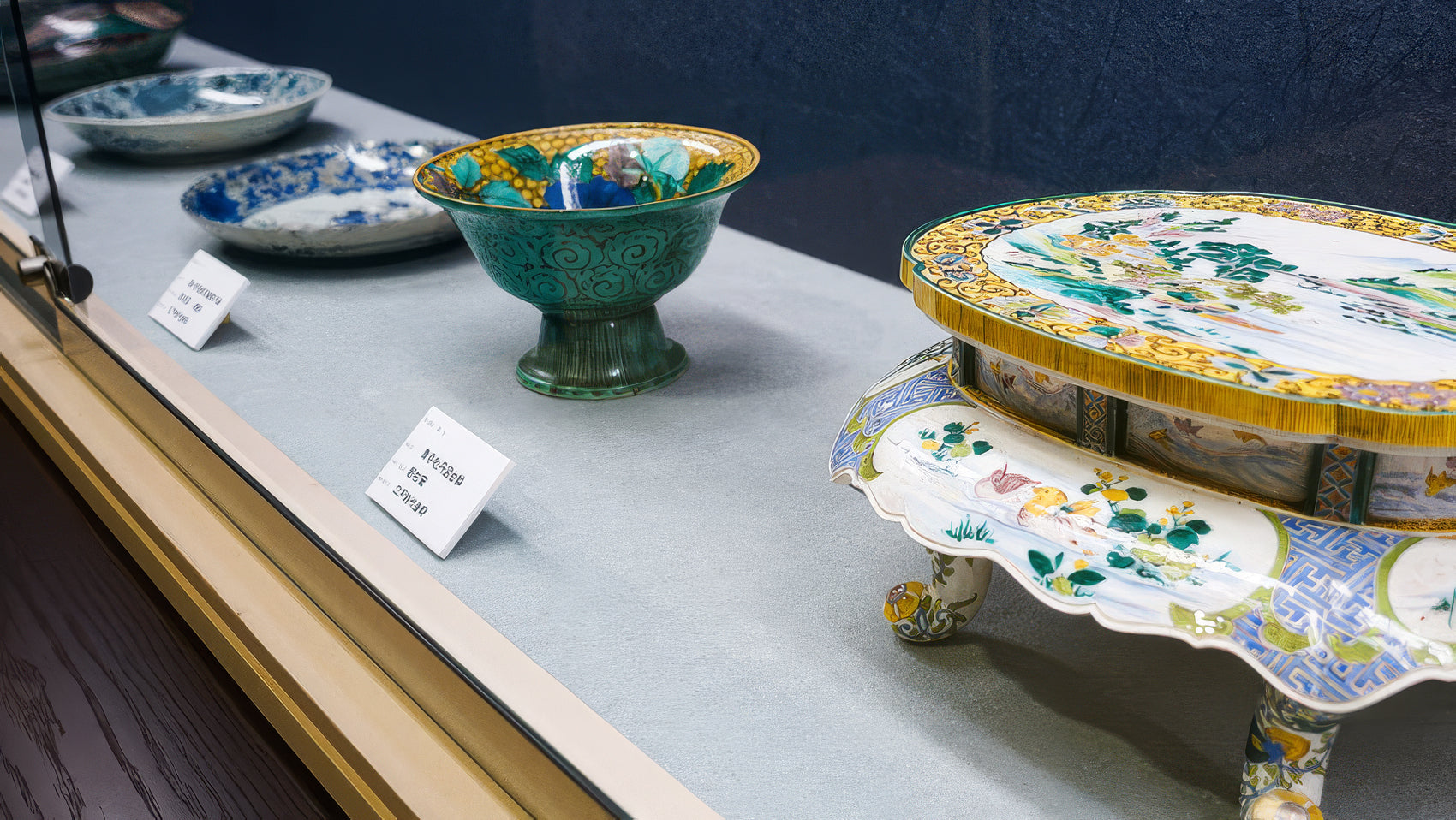
Director Nakaya of Gosaikan at The Kutani Porcelain Art Museum is a leading researcher in the history of Kutani ware, with extensive expertise ranging from early ko-Kutani to contemporary works. Among the many precious Kutani ware pieces exhibited at Gosaikan, Director Nakaya selected five works he would like people to see in particular. He also spoke about their appeal and distinctive features.
*All pieces are held by The Kutani Porcelain Art Museum.
The first piece is in the ko-Kutani aote style, characterized by a bold and powerful presence that evokes the heroic spirit of Japan’s warring era.
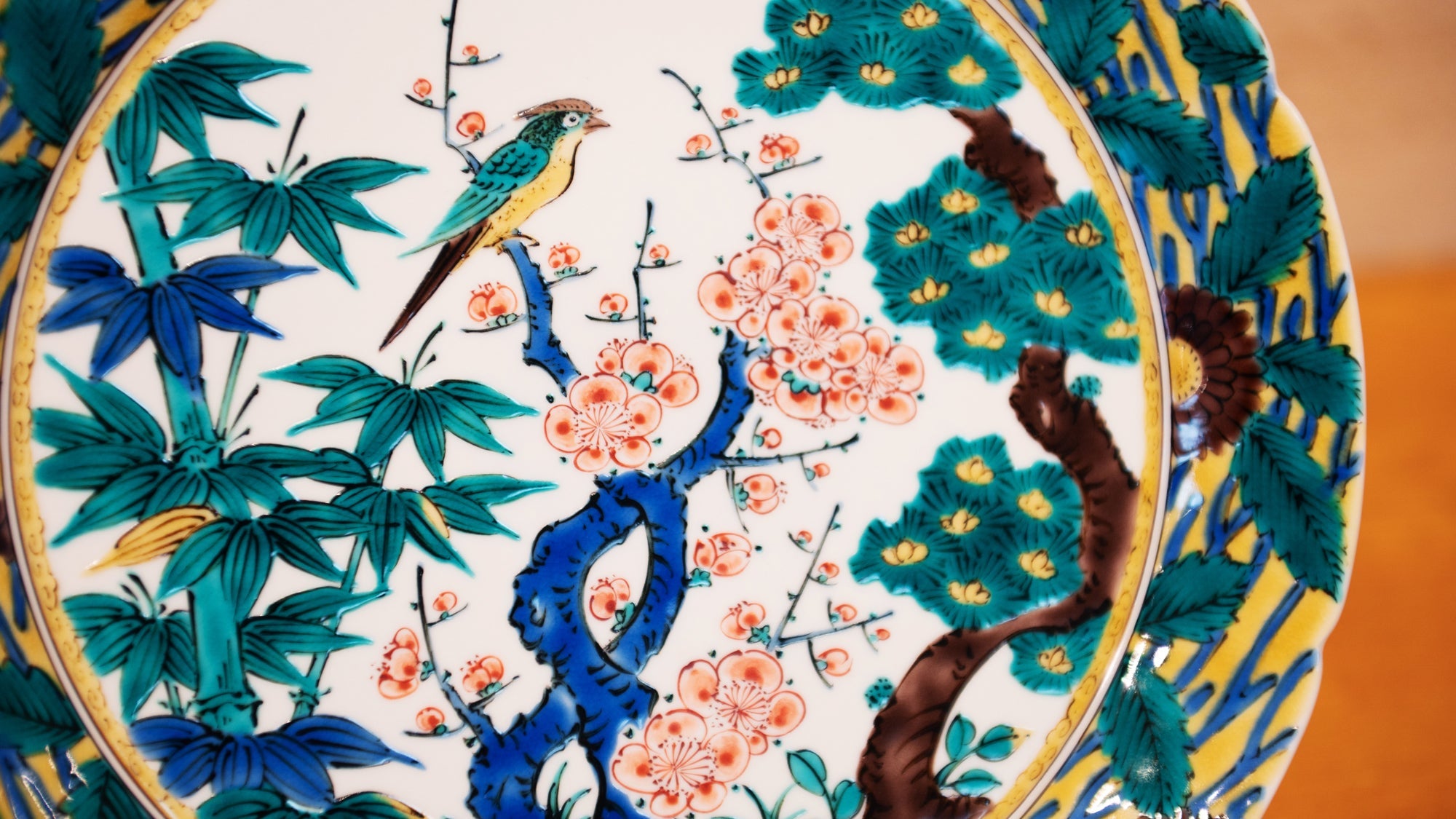
The Ko-Kutani Aote Basho-zu Hirabachi from the early Edo period (1603–1868 CE) is the first piece.

There are two styles within ko-Kutani. The first being aote, characterized by vivid colors covering the entire surface of the vessel, almost like an oil painting. The other is gosaide, which, like traditional Japanese paintings, leaves blank spaces to create a balanced composition.
“Personally, I prefer the aote style. Its bold brushwork, powerful lines, and rich palette of green, yellow, and purple never fail to captivate me,” Director Nakaya explains.

The allure of ko-Kutani lies in its powerful and extravagant expression. It reflects the aesthetic sensibilities inherited by the feudal lords from the Sengoku period (1467–1600 CE) through the Azuchi-Momoyama period (1568–1600 CE): elegant yet bold, sometimes raw, and full of a dynamic force that stirs the viewer’s spirit.
At the time, overglaze enamel porcelain was extremely rare in Japan, and its production techniques were largely unknown. Yet ko-Kutani incorporated advanced methods from the Ming dynasty, while avoiding direct imitation of their artistic expression. Instead, it established a completely original style.
Remarkably, a groundbreaking art form emerged from deep in the mountains of Kaga, far away from Kyushu, where Dejima served as Japan’s key gateway to foreign influence, during the isolationist sakoku era of the early Edo period.
This extraordinary achievement was made possible through the support of the Maeda clan. Crafted just when the Tokugawa shogunate was established in the early Edo period, ko-Kutani reflects the Maeda clan’s determination to “conquer the world through culture,” even within Tokugawa rule. The strength and bold dynamism of ko-Kutani still carry the majestic spirit of a warrior era shaped by conflict.

The gosu lines, or black outlines, drawn powerfully and without hesitation, despite being freehand, are truly magnificent. The woodgrain pattern around the rim flows with a steady rhythm, creating a world uniquely its own, an atmosphere found only in ko-Kutani. “The piece conveys a powerful energy,” Nakaya says, “almost as if proclaiming, ‘Behold this!’”
The second item is an aote piece crafted after the revival of Kutani ware. Enjoy comparing it with ko-Kutani from the Edo period.
Ko-Kutani refers to early Kutani ware. Its kilns operated for only about fifty years before the Maeda clan ceased the production of overglaze enamel porcelain. About a century later, Kutani ware resumed production in the same region, known as the revival of Kutani ware.
The second recommended piece is the Flat Bowl with Wild Birds and Turnips from Matsuyama Kiln. The Matsuyama Kiln was established specifically to revive the aote style of ko-Kutani.

While the colors follow the same aote style, the motifs of turnips and small birds are charming and heartwarming, giving the piece a distinctly different impression from its ko-Kutani predecessors.

Instead of evoking a sense of strength, this piece radiates gentle energy. More than 200 years had passed since the warring times, and the era in which this piece was created was much more peaceful. That tranquility is echoed in the painting style.
Director Nakaya says, “At Gosaikan, we encourage people to compare the aote style of ko-Kutani with the aote pieces from Matsuyama Kiln, and enjoy the differences.”
The third piece is an early work by Kutani Shoza. Attention is drawn to individual expressions and the patterns on the kimonos.
Kutani Shoza was a central figure in the Japan Kutani movement that sparked a Kutani ware boom in Europe during the Meiji era (1868–1912 CE). This third piece was created by Shoza in his early years.

Shoza developed the saishiki kinrande style during the early Meiji era. His works were exported to Europe, which contributed to their growing popularity and achieved great success. To reach this level of artistry, Shoza mastered a wide range of techniques, including akae saibyo. The Akae Hundred Elders Bowl is believed to be an early example of his akae saibyo work, produced at Ono Kiln.

Not only are the finely drawn lines stunning, but each person’s facial expressions, gestures, and movements are unique, and the patterns on their kimonos vary as well.

In fact, this piece bears kiln marks—scratches that occur during firing. One such mark can be found on the right side, along the cane held in both hands by one of the figures in this piece. The cane has been skillfully painted over the kiln mark to conceal it, making the imperfection barely noticeable. It’s a detail well worth observing when viewing the piece.
(Detailed photograph by Kutaniyaki MAG)
The fourth is an overglaze enamel porcelain piece also by Kutani Shoza, designed for holding water.
While at Ono Kiln, Shoza was greatly influenced by Aoya Genemon, a brilliant innovator in overglaze enamel who had also been invited to the kiln. Aoya created many fascinating works, while Shoza also painted pieces that reflect his own distinctive creativity.
The fourth piece to check is the Overglaze Enamel Landscape and Turtle Design Horse-Trough–Shaped Water Basin by Shoza.

“Although Shoza is best known for his finely detailed akae saibyo works and lavish saishiki kinrande pieces, his overglaze enamel works are equally compelling,” Nakaya notes. “The very idea of creating a washing basin in porcelain is remarkably inventive, and it is striking that the design was painted with the clear intention that the vessel would actually hold water.
“The outline of the turtle is intentionally distorted in certain areas. Once water is added, the turtle appears to come to life, as if it were moving. Shoza’s expressive power never ceases to impress.”

The fifth piece is a flat bowl by Shoza that suggests a possible connection between Itaya Hazan and Muroo Saisei.
Itaya is one of Japan’s most renowned ceramic artists, while Muroo is a celebrated poet and novelist from Kanazawa, Ishikawa Prefecture. This piece, titled Overglaze Enamel Flat Bowl with Morning Glories and Kittens, suggests the possibility that the two figures may have had some form of exchange.

The bowl depicts a kitten gazing up at a spider descending on a thread from a morning glory vine, a scene that is both playful and endearing. The piece is believed to have once been owned by Itaya. In addition, Muroo describes the imagery of this very bowl in detail in his short story Kutani Shoza, suggesting that Muroo may have seen the piece through Itaya.

“There is one more detail I would like visitors to notice,” Nakaya adds. “The two kittens depicted here stayed with me for some time. Feeling that I had seen them somewhere before, I looked into it and eventually found a very similar image in Katsushika Hokusai’s sketchbooks, which he prepared as drawing manuals for his students. Considering that Shoza may have referenced Hokusai’s sketchbooks reveals a different kind of historical resonance from ko-Kutani, one that is quietly exhilarating.”

Director Nakaya Shinichi, The Kutani Porcelain Art Museum, Gosaikan
Researcher of Kutani ware and its history. Former curator with the Kaga City Board of Education and the Kaga City Art Museum. Former deputy director of the Ishikawa Prefectural Kutani Ceramic Museum. Appointed director of The Kutani Porcelain Art Museum in 2016, a position he continues to hold.
He has supervised major exhibitions including Ko-Kutani Romance: The Magnificent Yoshidaya Kiln Exhibition (2006); The Tea Ceremonies of the Hosokawa Family and Kutani Ware of Kaga (2015, Eisei Bunko Museum); and Interacting Ceramics: The Lineage and Development of Kutani Ware (2015, Tokyo Station Gallery, commemorating the opening of the Hokuriku Shinkansen Line). During the latter exhibition, he served as guide during the visit of the Emperor Emeritus and Empress Emerita.
Co-author of Fudebako (Kutani Ware Issue) and Kutani Modern.
Popular posts

Categories


3 comments
@Louise – Thank you for sharing the story of your plate and what it means to you.
Regrettably, we are unable to offer appraisal or identification services. Japanese ceramics have a long and diverse history, with numerous kilns, makers, and styles that have evolved over many generations, making it challenging to provide detailed information about individual pieces.
While we regret that we cannot provide further information about your plate, we hope you continue to enjoy and treasure it.
Japan Kutani Shop
Greetings Mr. Shinichi,
I have a dish that I believe is Aode Ko-Kutani, two people have said absolutely not, but in my heart I believe it is.
Would you possibly like to see a photo?
It has repairs, so I doubt it’s valuable, but I love its beauty, and part of that beauty is its history.
I appreciate your time.
All the best,
Louise Murphy
Louise Murphy
Greetings Mr. Shinichi,
I have a dish that I believe is Aode Ko-Kutani, two people have said absolutely not, but in my heart I believe it is.
Would you possibly like to see a photo?
It has repairs, so I doubt it’s valuable, but I love its beauty, and part of that beauty is its history.
I appreciate your time.
All the best,
Louise Murphy
Louise Murphy
Leave a comment
This site is protected by hCaptcha and the hCaptcha Privacy Policy and Terms of Service apply.